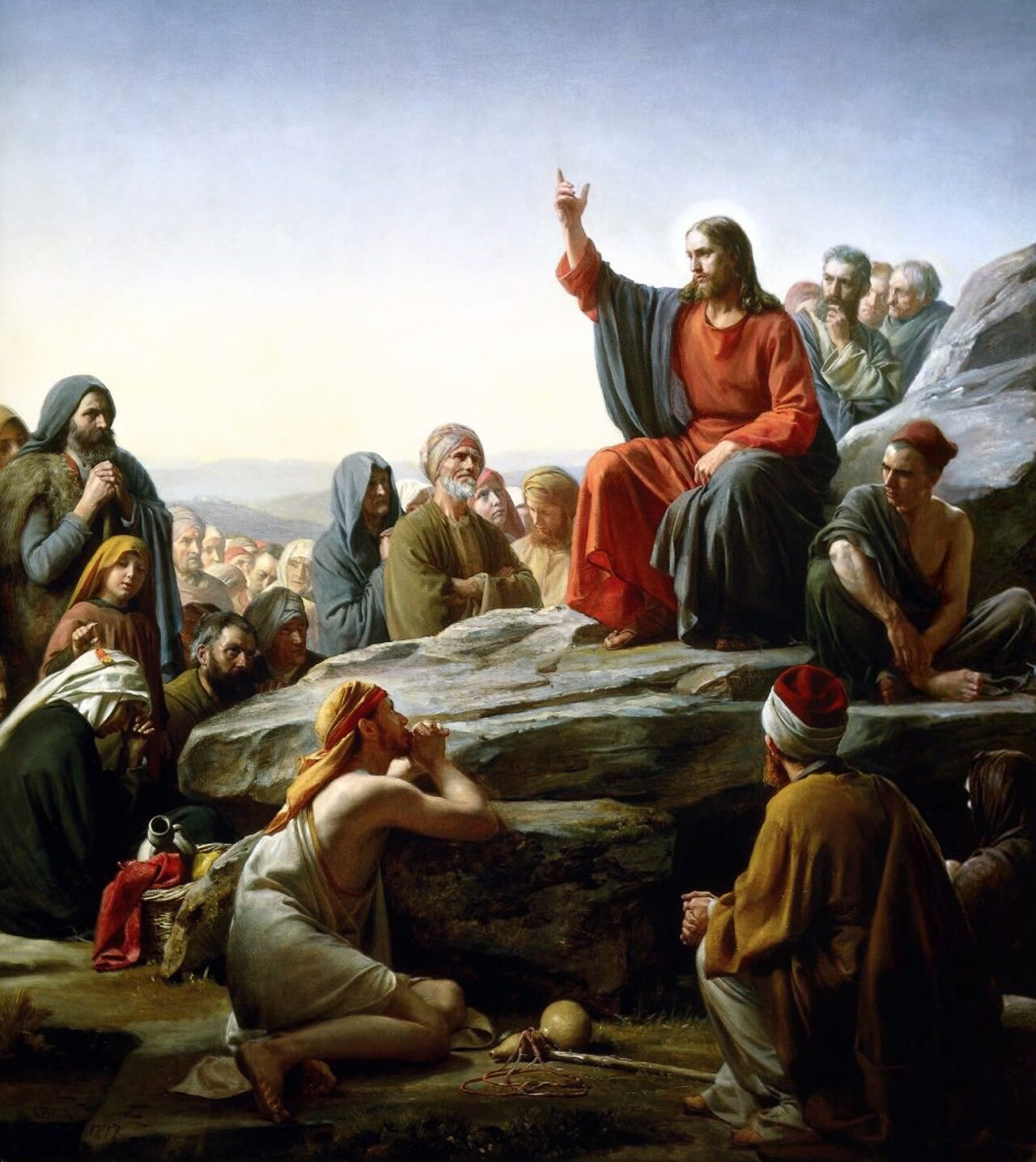
As we conclude this remarkable sermon, we are reminded again that Jesus is not offering a message that can be separated from Himself. The Sermon on the Mount is not merely a set of moral ideals. It is not a detached “ethic of the kingdom” that we may admire from a safe distance. Rather, His whole identity is expressed in and through His words. The teaching points to the Teacher. And our response to the teaching finally reveals our response to Him.
Matthew frames this sermon in a way that helps us see the significance of what has just occurred. It begins with a formal posture of authority and ends with a formal reaction of astonishment.
“When Jesus saw the crowds, He went up on the mountain; and after He sat down, His disciples came to Him. He opened His mouth and began to teach them” (Matthew 5:1–2). This is no casual conversation. This is the deliberate scene of a Rabbi who sits and speaks with the expectation that those who hear will listen carefully. But what the crowds heard was unlike anything they had encountered.
“When Jesus had finished these words, the crowds were amazed at His teaching; for He was teaching them as one having authority, and not as their scribes” (Matthew 7:28–29). The word for “amazed” carries the force of being stunned—almost dumbfounded. They were not merely interested. They were shaken by the weight of what they had just heard.
And the reason is clear: the scribes spoke by authority, but Jesus spoke with authority. There is a vast difference between the two.
The Authority That Does Not Borrow Its Weight
The scribes often appealed to other rabbis, other traditions, other schools of interpretation. Their authority was derivative. They cited and compared and weighed opinions. But Jesus says, again and again, “You have heard that it was said… but I say to you.” He does not merely explain Scripture. He speaks as One who stands over it—not in contradiction to it, but as its rightful fulfillment and final Interpreter.
Even the prophets spoke differently. They would say, “Thus says the Lord.” Jesus does not speak that way. He does not have to. He speaks in His own name: “Truly I say to you.” That is not the language of a mere messenger. It is the language of One who possesses the right to declare reality. It is dominical speech—the speech of the Lord Himself.
And if we stop long enough to consider what that implies, it is breathtaking. Jesus effectively claims that human wisdom and human folly are defined by a person’s reaction to His words. He insists that a life built on His teaching is wise and a life that refuses His teaching is foolish. He places Himself at the center of decision and destiny.
That is not something a sane man says if he is only a teacher. It is not the posture of a spiritual advisor offering helpful suggestions. It is the stance of a King.
The Jesus Who Will Not Be Divided
There is a temptation—common in every age—to attempt to separate Jesus from the fullness of who He is. Some will say, “I like the gentle Jesus. I like the moral Jesus. I like the Sermon on the Mount Jesus. But I do not like dogma.”
But we must understand what “dogma” is. It is simply teaching—doctrine. And no one can avoid doctrine. The person who says, “We have no doctrine; we just believe in Jesus,” is only revealing that he has not thought carefully. The moment you define who Jesus is, you are doing doctrine. The only question is whether your doctrine matches the Jesus who actually speaks in Scripture.
And in the Sermon on the Mount, Jesus makes it impossible to love an edited version of Him. Near the end of this sermon, He speaks words that should arrest us: “Depart from Me, I never knew you” (Matthew 7:23). Those are not the words of a mere moral philosopher. Jesus is claiming personal authority over the final outcome of human lives. He is claiming to know who belongs to Him, and who does not.
He is not simply giving instructions. He is making claims. He is saying, in effect, that the most important question is not whether we admire His teaching, but whether we know Him—and whether He knows us.
The Authority of the Messiah
Jesus’ authority is not only the authority of a consummate Teacher. It is also the authority of the Messiah—the Christ, the Anointed One on a mission.
In another context, when He speaks to the two disciples on the road to Emmaus, He begins “with Moses and all the prophets” and explains “the things concerning Himself” (Luke 24:27). That is a staggering claim: the Scriptures are about Me. The sacrifices, the priesthood, the tabernacle, the temple—these are not ends in themselves. They are anticipations and shadows. They point beyond themselves to the coming of Messiah.
This is why Jesus can say, “I did not come to abolish the Law and the Prophets, but to fulfill” (Matthew 5:17). Fulfillment means the One to whom they have been pointing has arrived. The time is fulfilled because the message and the Messenger are inseparable.
So we cannot drive a wedge between the Jesus who teaches and the Christ who saves, between the “Jesus of history” and the “Christ of faith.” That distinction collapses under the weight of the Gospels. Jesus understood who He was. And His words disclose that self-awareness with increasing clarity.
Lord: Not Merely Respected, but Obeyed
In the New Testament, the word Kurios can mean “sir” as a term of respect, but it can also mean “Master.” The context determines the meaning, and in the Sermon on the Mount the context makes the meaning unmistakable.
Jesus is not asking for polite admiration. He is calling for surrendered obedience. “Lord” in this sermon is not a title of courtesy; it is a confession of allegiance. He is not merely to be respected. He is to be obeyed.
And this matters because Jesus insists that eternal welfare is at stake in what we do with Him. In His words, the two possible ends are not vague destinies; they are personal encounters: the joy of the Master—“Well done… enter into the joy of your Master” (Matthew 25:21)—or banishment from His presence—“Depart from Me” (Matthew 7:23).
Those are the best words and the worst words a human being could ever hear. And Jesus speaks as the One who will say them.
The Purpose of God: Conformed to Christ
Jesus’ call to discipleship is not merely behavioral. It is transformational. The aim is not simply “do better.” The aim is “become new.”
Paul unfolds this beautifully in Romans 8. We cherish Romans 8:28—God causes all things to work together for good to those who love God, to those who are called according to His purpose. But Paul does not leave the purpose vague. The next verse tells us what that purpose is: “For those whom He foreknew, He also predestined to become conformed to the image of His Son” (Romans 8:29).
That is God’s purpose statement for the believer: conformity to Christ. There is no higher likeness. Spiritual formation, in the truest sense, is the gradual and progressive shaping of our lives into the image of Jesus.
This is not cosmetic. It is inside-out.
In your deepest self, God has declared you righteous—justified. Justification means you are declared righteous by the highest authority in the universe. There is no higher court of appeal. The righteousness of Christ has been imputed—credited—to your account.
That is why Paul can ask, “Who will bring a charge against God’s elect? God is the one who justifies” (Romans 8:33). And “Who is the one who condemns? Christ Jesus is He who died… who also intercedes for us” (Romans 8:34). Because He intercedes, because He holds, because He saves and sustains, Paul can climax with that triumphant certainty: nothing will be able to separate us from the love of God in Christ Jesus our Lord (Romans 8:38–39).
Jesus says the same reality in His own words: you are in His hand, and no one can snatch you out (John 10:28–29). You are held by the grip of God and the grip of grace.
Christ in You: The Hope of Glory
Yet we all know another reality: while we are declared righteous, we are not yet fully conformed. Our thoughts, wills, emotions, habits, and patterns still require transformation. The new life is real, but its expression is still unfolding.
This is why Paul can speak of “Christ in you, the hope of glory” (Colossians 1:27). The life of Christ is not merely an external example to imitate. It is an internal presence that remakes us.
And this is why I like to express the Christian life in a simple sequence:
Jesus Christ gave His life for you (the cross),
so that He could give His life to you (new life),
so that He could live His life through you as you (transformation).
This is crucial. Many believers spend years trying to do things for Jesus, as though the Christian life were a strenuous project of religious effort. But the invitation is deeper: stop trying to manufacture righteousness and instead invite Jesus to express His life through you.
And when I say “as you,” I mean it. God does not make clones. As you are conformed to Christ, you do not become less personal—you become more truly yourself. Conformity to the world produces sameness; conformity to Christ produces uniqueness. You become, in a deeper sense, the person God intended you to be.
The world will try to define you by externals—by environment and heredity, by the pressures of culture and the patterns of the past. But the gospel begins to define you by the internal and the eternal. Over time, you begin to reflect and refract the glory of God in a way no one else can. And that is part of the beauty of the coming kingdom: countless redeemed people, each uniquely displaying God’s glory in boundless variety.
We are not home yet. We are being prepared.
Knowing God and Knowing Yourself
This also means we cannot fully know ourselves apart from God. There is a double knowledge: knowing God and knowing self. The more you know Him, the more you begin to understand who you truly are. The culture tells people to “find themselves,” but the paradox of the gospel is that you do not find yourself by curving inward. You find yourself by losing yourself and finding Him.
Jesus used an image like this: “Unless a grain of wheat falls into the earth and dies, it remains alone; but if it dies, it bears much fruit” (John 12:24). Death leads to life. Surrender leads to freedom. The self that clings to control remains small; the self that yields to Christ becomes fruitful.
Paul adds another dimension: “From now on we recognize no one according to the flesh” (2 Corinthians 5:16). We learn to see people as eternal beings, with dignity and destiny. “If anyone is in Christ, he is a new creature; the old things passed away; behold, new things have come” (2 Corinthians 5:17).
John captures the wonder of this identity: “See how great a love the Father has bestowed on us, that we would be called children of God; and such we are” (1 John 3:1). And then he adds that we cannot yet imagine what we will become, but we know this: “When He appears, we will be like Him, because we will see Him just as He is” (1 John 3:2).
Hope purifies. Future glory reshapes present choices (1 John 3:3).
God sees us already in light of what we will be. Romans 8 says that those He justified, He also glorified (Romans 8:30). God is not bound by time. He sees the finished work. And He is faithful to complete what He began.
Jesus the Judge and the Criterion of Judgment
All of this leads back to the central claim Jesus makes in this sermon: He has authority as Lord, as Savior, and as Judge.
Scripture teaches that God is Judge. And yet Jesus speaks as though He Himself will render the final verdict. He claims authority to decide and declare destiny. He even implies that He is the criterion of judgment.
“What did you do with My words? What did you do with Me?” is the heart of the matter.
To be with Him forever is the greatest possible good. To be banished from His presence is the greatest possible loss. These are words no mere man would speak. They are words of the Son of the living God.
And therefore the end of the sermon confronts us with a decision. We must either embrace Him or reject Him. We cannot ignore His claims and retain our integrity. Not to choose is to choose. Agnosticism is not a neutral position; it is the illusion of neutrality without the reality.
Intellectual Integrity and an Open Heart
This is why, when I am speaking with someone who does not know Christ, I often appeal to intellectual integrity: you cannot reasonably accept or reject Jesus without first hearing Him. And in our time, many people reject a secondhand caricature. They have not read the Gospels. They have absorbed opinions.
So I will say: if you want integrity, read one of the Gospels—John is often a good place to start—and ask God, even if you are uncertain He exists, to reveal Himself: “God, I don’t know if You are there, but if You are, show me Yourself in this book.”
That posture matters. Jesus says, “If anyone is willing to do His will, he will know of the teaching, whether it is of God” (John 7:17). The entry point is not merely the intellect. It is the will. If a person responds to the light he has, God provides more light. But if a person rejects the light he has received, more light would not help.
John 16 says the Spirit convicts the world of sin, righteousness, and judgment (John 16:8). Our responsibility is faithfulness. God is responsible for results. Evangelism is a process. We cast bread on the waters. God alone knows the outcomes.
But the central issue remains: it is not merely the mind. It is the heart. It is surrender.
Someone once put it well: the root of an unsatisfied life is an unsurrendered heart.
The Sermon’s Final Call
So we end where we began: with Jesus, the Teacher who cannot be separated from His teaching.
He sits on the mountain and opens His mouth, and the words that come are timeless, universal, piercing. They challenge our inherited traditions and our hidden evasions. They confront us with the necessity of response.
And the crowds were dumbfounded because they sensed what we must also sense: this Man speaks with authority.
Not merely authority to teach.
Authority to command.
Authority to save.
Authority to judge.
Which means that, as the sermon ends, the question is not merely, “What do you think of His teaching?” It is, “What will you do with Him?”
Because in the end, everything in this sermon points to Christ—and every response to the sermon is finally a response to the King.
Questions for Reflection
- Where am I tempted to admire Jesus’ teaching without yielding to Jesus’ authority? What would obedience look like in one specific area of my life right now?
- Do I treat Jesus’ words as timeless truth that judges my assumptions—or as suggestions I can filter through my preferences? What “tradition” or habit of mind might He be challenging in me?
- How would my daily life change if I truly believed that my eternal welfare is bound up with knowing Christ—and being known by Him? What competes with that intimacy?
- In what ways am I still trying to live “for Jesus” in my own strength, rather than inviting Jesus to live His life in me, through me, and as me? What step of surrender is God inviting me to take this week?