One of the most profound mysteries in the Christian faith is the doctrine of the Trinity. When we begin to explore this truth, we are not merely examining a theological idea. We are coming to the very heart of reality itself. The Trinity reveals who God is and, in doing so, helps us understand who we are meant to be.
Before we examine the Trinity directly, it is helpful to recall some of the attributes of God we have already considered. Scripture reveals two broad categories of divine attributes. Some belong to God alone and transcend human experience. Others reflect aspects of God’s character that we share because we are created in His image.
The first group is often called incommunicable attributes. These include qualities such as God’s independence, eternity, immutability, and omnipresence.
God is completely independent. Unlike us, He depends on nothing. Our lives are sustained by countless external factors. We depend on air, food, water, and a stable environment. God requires none of these things. His existence is entirely self-sustaining.
God is also unchanging. Everything in our world changes. Our bodies age, circumstances shift, and our thoughts evolve. But God never changes in His character or His purposes. His goodness and faithfulness remain constant.
God is eternal as well. He exists beyond time and space. Time belongs to the created order, but God transcends it. We live within time, moving from past to present to future. God stands above time while still working within it.
Another attribute is omnipresence. God is present everywhere at once. We have no human category for this reality because we are always limited to one location at a time.
We also saw that God possesses perfect unity. He is not composed of parts. Everything that God is, He is completely.
Alongside these attributes are what theologians call communicable attributes—qualities that reflect God’s personal nature and that we share in a limited way because we are made in His image.
Human beings are spiritual creatures. We possess body, soul, and spirit. Our body allows us to interact with the physical world. Our soul gives us the ability to know ourselves and relate to others. Our spirit enables us to commune with God.
We are also moral beings. Unlike animals, we recognize moral responsibility. We have a sense of right and wrong and an awareness that our lives carry meaning. Scripture also tells us that God has placed eternity in our hearts.
Because of this, nothing in the world can fully satisfy us. Achievements, possessions, relationships, and status all fall short. Eventually we discover that what we truly long for is God Himself.
God also possesses knowledge, wisdom, and truthfulness, and we can share in these qualities to some degree. His moral attributes—goodness, mercy, holiness, and peace—can also be reflected in our lives as we grow in relationship with Him.
God acts with purpose, and He calls us to live purposeful lives as well. It always amazes me that many people have mission statements for their businesses but not for their lives. Yet Scripture calls us to meaningful and intentional living.
Ultimately, God invites us into a process of transformation. I often describe the gospel this way: the gospel is God’s offer of His power to make us the people He intended us to be all along.
We no longer have the ability to become those people on our own. But God provides His power through Christ and the Holy Spirit so that this transformation becomes possible.
A central part of that transformation is learning to live in loving relationships. The two greatest commandments—to love God and to love our neighbors—reflect the nature of God Himself.
This brings us to the doctrine of the Trinity.
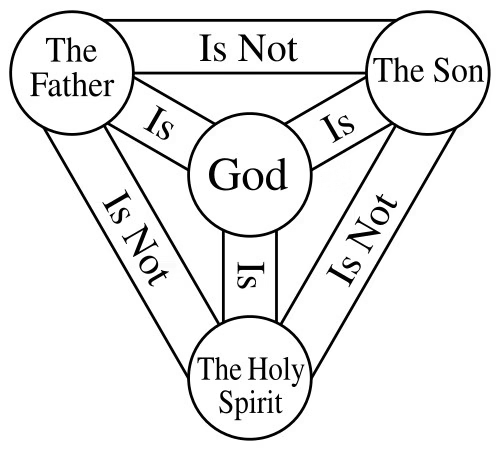
The Trinity teaches that God exists eternally as three persons: Father, Son, and Holy Spirit. Each person is fully God, and yet there is only one God.
We might describe this as tri-unity. God is one in essence but three in persons.
Many people struggle with this idea because it seems mysterious. Yet the Trinity provides the foundation for understanding love and relationship. Love requires both a subject and an object. There must be an “I” and a “Thou.”
A purely self-directed relationship cannot satisfy. It would be like Narcissus falling in love with his own reflection. Genuine love requires relationship between persons.
Within the Trinity, love has existed eternally. The Father loves the Son, the Son loves the Father, and the Holy Spirit shares in this communion of love.
Because we are created in God’s image, we also long for relationship. Our deepest fulfillment is found not in isolation but in communion with God and with others.
This truth challenges modern Western individualism. The biblical vision of life calls us beyond self-focused independence into covenant relationships.
Scripture reveals the Trinity progressively. In the Old Testament we see hints of plurality within the unity of God. For example, in Genesis 1:26 God says, “Let us make man in our image.” Similar language appears in Genesis 3:22 and Genesis 11:7. Isaiah 6:8 also contains both singular and plural language when God says, “Whom shall I send, and who will go for us?” Other passages distinguish between different persons who are called God. Psalm 110 speaks of the Lord saying to another Lord, “Sit at my right hand.” Isaiah 63 refers to God’s Spirit being grieved. These passages hint at the complexity of God’s nature.
In the New Testament, however, the doctrine becomes much clearer. One of the clearest passages appears in the Great Commission. Jesus commands His followers to baptize disciples in the name of the Father and the Son and the Holy Spirit. The word “name” is singular, yet three persons are mentioned. This reflects both unity and diversity.
Another striking example occurs at the baptism of Jesus. The Son is baptized, the Spirit descends like a dove, and the Father speaks from heaven: “This is my beloved Son.”
Several New Testament passages place the three persons together in a similar way. Paul writes of “the grace of the Lord Jesus Christ, the love of God, and the fellowship of the Holy Spirit.”
From these texts we can summarize the biblical teaching in three statements:
- God is three persons.
- Each person is fully God.
- There is one God.
Many misunderstandings arise when people deny one of these truths.
Some deny that God is three persons. Others deny the full deity of Christ or the Holy Spirit. Still others assume that Christians believe in three gods. But the biblical teaching holds all three truths together.
The New Testament repeatedly affirms the full deity of Christ. In John’s Gospel we read, “In the beginning was the Word, and the Word was with God, and the Word was God.” Later Thomas addresses the risen Jesus as “My Lord and my God.”
Scripture also teaches that the Holy Spirit is divine. Believers are called the temple of God because the Spirit dwells within them.
At the same time, the Bible consistently affirms that there is only one God. The great confession of Israel declares, “Hear, O Israel: The Lord our God, the Lord is one.”
The doctrine of the Trinity therefore holds together both unity and diversity.
Theologians sometimes describe two aspects of this doctrine. The ontological Trinity refers to who God is in His eternal being. The economic Trinity refers to the different roles the Father, Son, and Spirit play in creation and redemption. The Father sends the Son. The Son accomplishes redemption through His life, death, and resurrection. The Holy Spirit applies that redemption in the lives of believers. These roles do not imply inequality. The Father, Son, and Spirit are co-eternal and co-equal. Yet they relate to one another in ways that reveal both unity and distinction.
Within the Trinity we see the perfect harmony of authority and equality, unity and diversity, and love and relationship.
And that is why the doctrine of the Trinity matters.
The gospel itself depends on it. If Christ were not fully God, His sacrifice could not fully atone for the sins of the world. If the Spirit were not divine, He could not bring new life to believers.
The Trinity therefore stands at the center of Christian faith. And through Christ and the Spirit we are invited into the life of the triune God Himself.
To explore this topic more deeply and discover how to thoughtfully answer the questions below, subscribe to Ken Boa Reflections on Substack.
Questions for Reflection
- How does the doctrine of the Trinity deepen your understanding of God’s nature as relational and loving? Reflect on how the eternal relationship between the Father, Son, and Holy Spirit shapes the way we understand love itself.
- In what ways might modern individualism prevent us from living out the relational life God designed for us? Consider how being created in the image of a triune God calls us into deeper community with God and with others.
- Why is it important to affirm all three biblical truths about the Trinity—that God is three persons, each person is fully God, and there is only one God? Think about how denying any one of these truths affects our understanding of Christ, salvation, and the nature of God.
- How does the work of the Father, Son, and Holy Spirit in salvation shape your personal relationship with God today? Reflect on the roles of the Father who sends, the Son who redeems, and the Spirit who transforms believers.