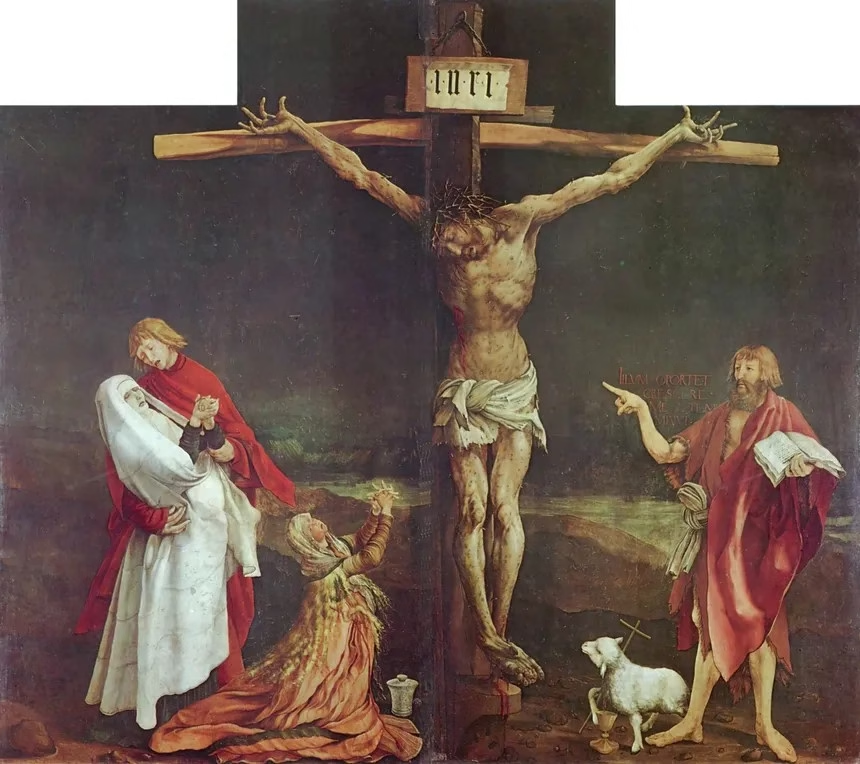
The doctrine of the atonement stands at the very center of the Christian life. It answers the deepest questions of our existence: How can sinful people be reconciled to a holy God? How can justice and mercy meet? And how can we find a righteousness that we ourselves could never achieve?
At its core, the atonement is the work that Jesus Christ accomplished through His life and death to secure our salvation. It is essential to understand from the outset that this salvation is not something we earn. In our culture, we are conditioned to believe that effort leads to reward, that performance leads to acceptance. But the gospel turns this assumption upside down. While effort has a role in our spiritual growth, earning has no place in our salvation. These two ideas must never be confused.
The reason is simple but sobering: God’s standard is perfection. It is not enough to behave well on the outside. God evaluates our thoughts, our motives, and the intentions of our hearts. When measured against this standard, every one of us falls short. There has only been one person in all of human history who has met this standard perfectly—Jesus Christ. He alone lived a life that was flawless in thought, word, and deed. Because of this, He alone is qualified to accomplish what we could never do for ourselves.
This leads us into the mystery of who Christ is. The atonement cannot be understood apart from the identity of the One who accomplished it. Jesus is not merely a great teacher or moral example; He is the God-man. This means that He possesses both a fully divine nature and a fully human nature, united in one person. This truth, though difficult to fully comprehend, is essential. If He were only human, His sacrifice would be insufficient. If He were only divine, He could not truly represent us. But because He is both, He is uniquely qualified to bridge the gap between God and humanity.
There is also a profound truth about His existence. The human nature of Jesus began in time, but the Son of God has always existed. There was never a moment when the Son was not. This reminds us that the atonement is not an afterthought in God’s plan. It is rooted in His eternal nature and purpose. The Father, the Son, and the Holy Spirit exist in perfect unity, and the work of redemption flows out of this divine relationship.
When we consider why Christ came, His own words give us clarity. He declared that He came to serve and to give His life as a ransom for many. The concept of a ransom is powerful. It implies that a price must be paid to secure freedom. Humanity is in bondage to sin and cannot free itself. No amount of self-improvement or moral effort can break these chains. But Christ pays the price in full. His life becomes the cost of our redemption.
He also said that He came to seek and to save that which was lost. This reveals something remarkable about the heart of God. We often think of ourselves as seekers of God, but the truth is that God is the ultimate seeker. He is the one who pursues us, who draws us, and who initiates the relationship. This changes the way we understand our faith. It is not based on our search for God, but on His relentless pursuit of us.
In addition, Jesus declared that He had completed the work the Father had given Him to do. This statement is filled with significance. The work of redemption was not partial or unfinished. It was completed. Though the effects of that work continue to unfold in history, the decisive act has already taken place. This gives us a foundation of confidence. Our salvation does not depend on something that might happen in the future, but on something that has already been accomplished.
The apostle Paul provides one of the clearest explanations of the atonement in his letter to the Romans. He begins by establishing the universal problem: all have sinned and fall short of the glory of God. This includes both those who have the law and those who do not. No one is exempt. This diagnosis is essential, because we cannot appreciate the solution until we understand the depth of the problem.
Paul then introduces the solution in one of the most powerful passages in Scripture. He explains that we are justified as a gift by God’s grace through the redemption that is in Christ Jesus. Justification means that we are declared righteous before God. This is not because we have become perfect in ourselves, but because Christ’s righteousness is credited to us. It is a legal declaration, grounded not in our performance but in His.
Redemption, as we have seen, refers to the price that has been paid to secure our freedom. But Paul also uses another important term: propitiation. This word addresses the issue of God’s wrath. God is not indifferent to sin. His holiness requires that sin be judged. But through the sacrifice of Christ, that wrath is satisfied. The penalty that we deserved is borne by Him. As a result, God’s relationship to us is transformed—from wrath to favor.
This brings us to one of the most profound truths in all of Scripture: there is now no condemnation for those who are in Christ Jesus. This is not merely a comforting idea; it is a definitive statement of our position before God. If we are in Christ, we are no longer under judgment. The case against us has been fully resolved. The verdict has been declared once and for all.
This truth has enormous implications for how we live. Many believers struggle with guilt and fear, as though they are still under God’s condemnation. They may intellectually believe in forgiveness, but emotionally they feel distant or unworthy. The message of the atonement calls us to a different posture. It invites us to rest in what Christ has done, rather than striving to prove ourselves.
At the same time, this does not lead to passivity or indifference. Grace does not eliminate effort; it redefines it. We no longer strive to earn God’s favor, but we do respond to His grace with obedience and devotion. Our efforts become an expression of gratitude rather than a means of achieving acceptance.
There is also a profound mystery woven throughout all of this. The atonement intersects with other great mysteries of the faith—the Trinity and the person of Christ. These are not problems to be solved, but realities to be embraced. They remind us that God is infinitely greater than our understanding. We can grasp aspects of His work, but we will never exhaust its depth.
And yet, even within this mystery, the message is clear. God has provided everything we need for our salvation. He has done for us what we could never do for ourselves. The righteousness He requires is the righteousness He provides. This is the heart of the gospel.
As we reflect on these truths, we are invited to respond in several ways. First, we are called to trust—to place our confidence not in our own efforts, but in the finished work of Christ. Second, we are called to rest—to live in the freedom that comes from knowing that our standing with God is secure. Third, we are called to live—to allow the reality of the atonement to shape our thoughts, our attitudes, and our actions.
In the end, the atonement reveals both the seriousness of sin and the greatness of God’s love. It shows us that our need is far deeper than we often realize, but also that God’s provision is far greater than we could ever imagine. It is here, at the cross, that justice and mercy meet, that righteousness and grace are brought together, and that we find the hope that transforms both our present and our future.
This is not merely a doctrine to be studied. It is a reality to be embraced, a truth to be lived, and a gift to be received with humility and gratitude.
To explore this topic more deeply and discover how to thoughtfully answer the questions below, subscribe to Ken Boa Reflections on Substack.
Questions for Reflection
- In what ways have I been relying on my own efforts to “earn” what can only be received through the finished work of Christ?
- How does the truth that Christ pursued me—rather than my seeking Him first—reshape my understanding of God’s love and initiative in my life?
- What does it mean, in practical terms, for me to live each day in light of the reality that there is now “no condemnation” for those who are in Christ Jesus?
- How can I more intentionally integrate the work of Christ—His life, death, and resurrection—into the way I think, speak, and act in my daily walk with Him?