The Christian life is not built on abstract ideas, but on living realities. When we consider the atonement and the resurrection of Jesus Christ, we are not dealing with distant theology—we are encountering truths that shape our identity, our purpose, and our daily walk with God.
At the heart of the gospel is the reality that we cannot change ourselves. The problem is not merely external behavior; it is the human heart. We may try to improve our lives, adjust our habits, or discipline our actions, but these efforts cannot transform us at the deepest level. This is what might be called “bootstrap theology”—the idea that we can lift ourselves up by our own effort. Scripture makes it clear that this approach will always fall short.
Because the problem is internal, the solution must also be internal. This is why the atonement is necessary. Christ did not simply come to give us better instructions; He came to reconcile us to God and to deal decisively with sin. Through His life and death, He made satisfaction for our sin and made it possible for us to stand accepted before a holy God.
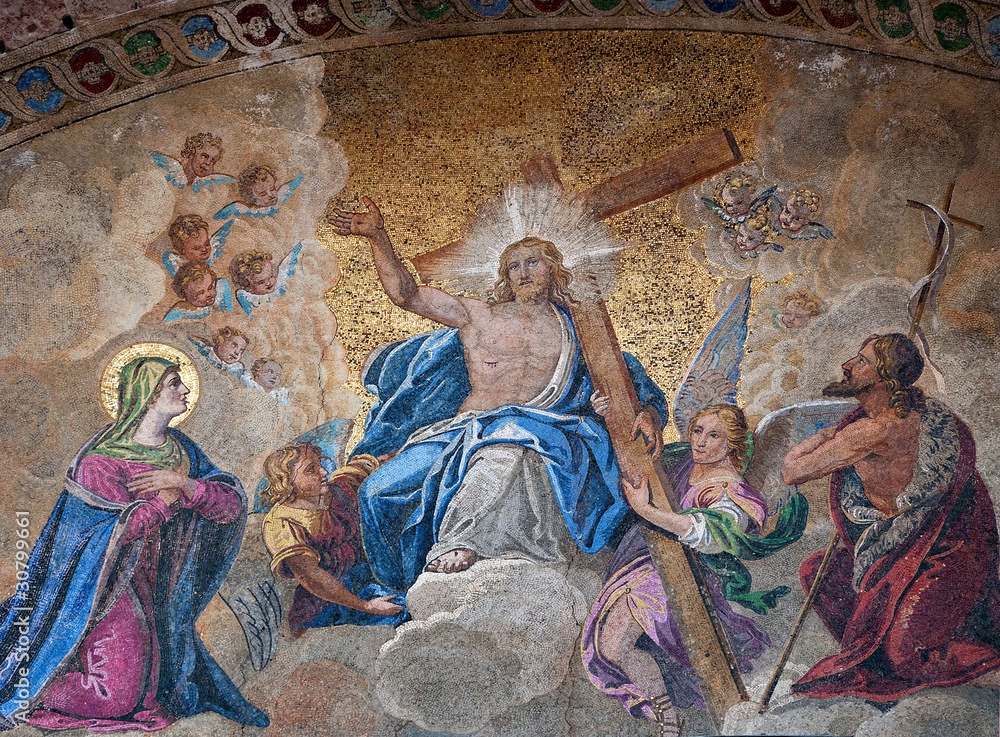
But the atonement is only part of the story. The resurrection completes the picture and gives it power. Without the resurrection, the cross would be an incomplete victory. The resurrection demonstrates that Christ has conquered sin and death. It also shows that the Father has accepted the work of the Son.
When we come to faith in Christ, something profound happens. We are not merely forgiven; we are identified with Him. His death becomes our death. His burial becomes our burial. His resurrection becomes our resurrection. This means that our past, present, and future are now tied to His. Our destiny is shaped by His destiny.
This gives us a new identity. We are no longer defined by Adam, by sin, or by our failures. Instead, we are defined by Christ. We are given a new dignity and a new capacity. God offers us His power so that we can become the people He created us to be—something we could never accomplish on our own.
There has been much discussion over the extent of the atonement—whether Christ died for all people or only for those who believe. While thoughtful believers have different perspectives on this issue, it is important to recognize that Scripture contains elements that support both views. Some passages emphasize the broad offer of salvation to the world, while others focus on God’s particular work in the lives of believers.
Rather than forcing a simplistic answer, it is wise to acknowledge the mystery. God is sovereign, yet human choices are real. The invitation of the gospel is extended to all—“whoever will may come”—and yet not all respond. This tension reminds us that we are dealing with realities that go beyond our full understanding.
What is clear, however, is that not all will be saved. Jesus Himself spoke of a narrow gate that leads to life and a broad road that leads to destruction. This is not an easy teaching, but it is a necessary one. It reminds us that the gospel is not merely one option among many, but the way of life.
At the same time, the offer of salvation is genuine. Christ’s death is sufficient, and His invitation is sincere. We can say with confidence that He offers forgiveness to all who will receive it. The issue is not whether the gift is available, but whether it is accepted.
For those who trust in Christ, there is a remarkable assurance. The wrath of God against sin has already been satisfied. This means that the believer will never experience God’s wrath as judgment for sin. That does not mean we will never experience suffering. In fact, suffering is part of the Christian life. But for the believer, suffering is not punishment—it is discipline, refinement, and growth.
This distinction is crucial. It changes the way we interpret our circumstances. Instead of seeing hardship as evidence of God’s displeasure, we can see it as part of His loving work in shaping us into the image of Christ.
The resurrection also has profound implications for our future. Christ’s resurrected body was not merely a return to His previous state; it was a transformation into a new kind of life—one that is no longer subject to weakness, decay, or death. This is the kind of life that awaits us as well.
Scripture describes our future bodies as imperishable, glorious, and powerful. They will be fully suited for the life God intends for us. This challenges the common idea that the physical body is something to escape. Instead, the biblical vision affirms that the body is good, and that it will be redeemed and restored.
Even now, the power of the resurrection is at work within us. Because Christ is alive, we are no longer slaves to sin. We have the ability, through the power of the Spirit, to say no to sin and yes to righteousness. This does not mean we will live perfectly, but it does mean that we are no longer helpless.
There is, however, an ongoing struggle. As long as we live in this present world, we experience a tension between our new identity in Christ and the lingering presence of sin. The apostle Paul describes this struggle vividly. There is a part of us that desires to do what is right, and another part that pulls us in the opposite direction.
This tension can be discouraging, but it is also a sign of spiritual life. The very fact that we are aware of the struggle shows that something has changed within us. Our deepest identity is now aligned with Christ, even though our thoughts, emotions, and habits are still being transformed.
The key to growth is not perfection, but direction. At each moment, we have a choice: to walk by the Spirit or to walk by the flesh. As we repeatedly choose to rely on the Spirit, our character is gradually shaped. Over time, what is true of us internally becomes more visible externally.
It is also important to understand that growth involves increasing sensitivity to sin. As we mature, we become more aware of attitudes and actions that we may have previously ignored. This is not a sign of failure, but of progress. It shows that we are becoming more aligned with God’s holiness.
In this process, confession plays a vital role. To confess our sin is not to earn forgiveness, but to agree with God about what is true. It is to acknowledge our need and to receive the forgiveness that has already been secured through Christ.
We must also be careful not to fall into the trap of guilt and condemnation. The enemy often seeks to convince us that we have failed too many times, that God is tired of forgiving us. But Scripture gives us no such limit. God’s grace is greater than our sin, and His patience is deeper than we can imagine.
Finally, the resurrection gives meaning to our present efforts. Because Christ is alive, our work is not in vain. What we do in obedience to Him has eternal significance. This gives us motivation to remain steadfast, even when the results are not immediately visible.
In the end, the atonement and the resurrection are not merely doctrines to be understood—they are truths to be lived. They call us to trust in what Christ has done, to rely on His power, and to walk in the new life He has given us.
As we grow in this understanding, we begin to see that the Christian life is not about trying harder, but about trusting deeper. It is not about becoming someone we are not, but about becoming who we already are in Christ. And it is not about earning God’s favor, but about living in the freedom of His grace.
To explore this topic more deeply and discover how to thoughtfully answer the questions below, subscribe to Ken Boa Reflections on Substack.
Questions for Reflection
- In what ways am I still trying to change myself through external effort rather than relying on Christ to transform my heart from within?
- How does my understanding of being identified with Christ’s death and resurrection reshape the way I view my identity and daily choices?
- When I experience struggle with sin, do I see it as defeat—or as an opportunity to depend more deeply on the power of the Holy Spirit?
- How does the reality of Christ’s resurrection—both now and in my future—give meaning, hope, and motivation to the way I live today?