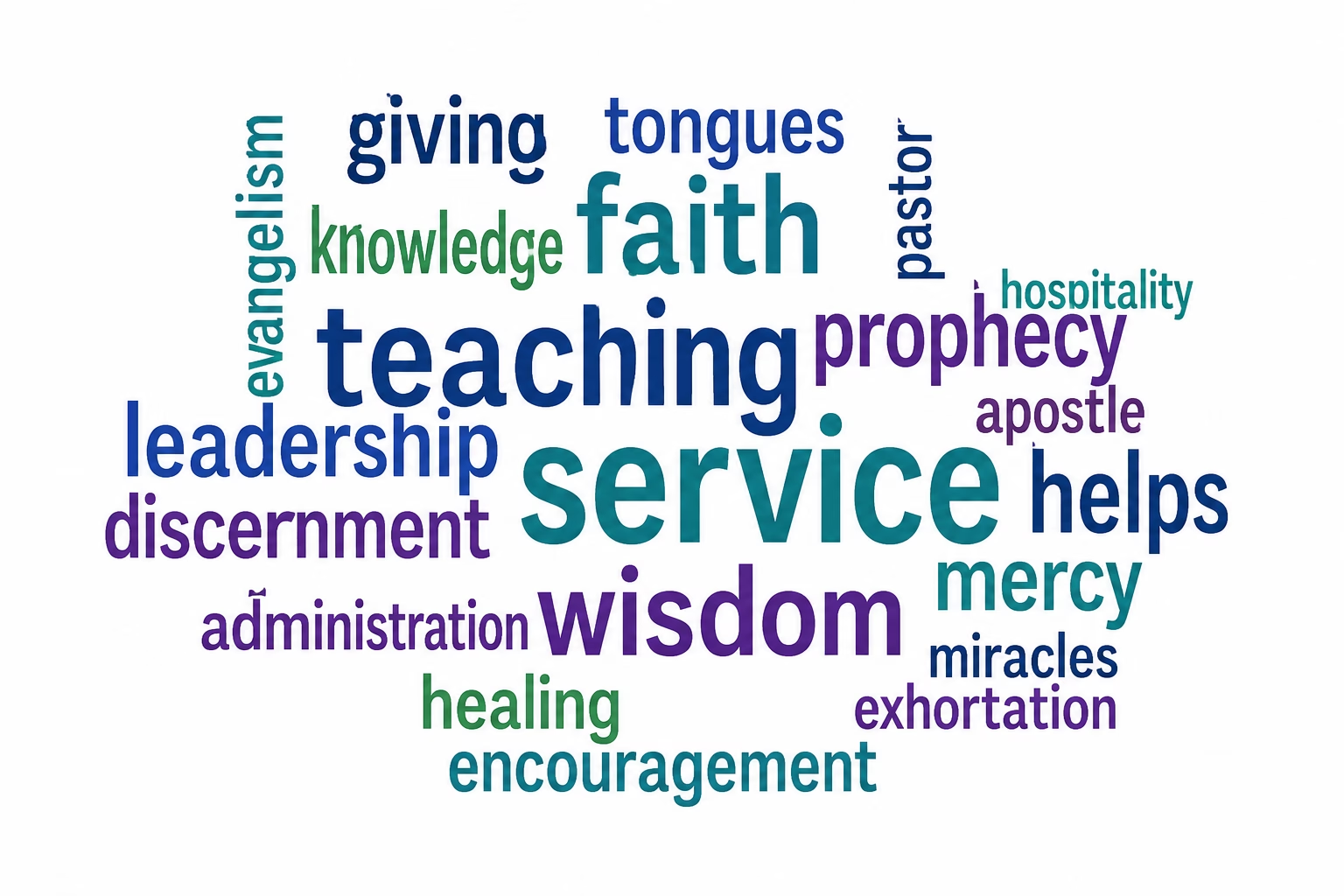
The gifts of the Holy Spirit are deeply connected to our purpose, ministry, and effectiveness in the body of Christ. God has not called believers to live powerless lives. He has equipped His people with spiritual gifts so that they can serve one another, strengthen the church, and glorify Him. These gifts are not meant to draw attention to ourselves but to point people to Christ.
A spiritual gift is an ability empowered by the Holy Spirit and used in ministry. Some gifts seem closely related to natural abilities, such as teaching, leadership, encouragement, or mercy. Others appear more extraordinary, such as prophecy, healing, or discernment. Yet Scripture does not sharply divide gifts into “natural” and “supernatural” categories. All gifts ultimately come from God and are expressions of His grace.
The New Testament reveals a greater manifestation of the Holy Spirit’s power than was commonly seen in the Old Testament. In earlier times, there were occasional demonstrations of miraculous power through people such as Elijah and Elisha, but with the coming of Christ and the outpouring of the Spirit at Pentecost, a new era began. Jesus demonstrated the power of the kingdom through His teaching, healings, and authority over demons. He also empowered His disciples to preach the gospel, heal the sick, and proclaim the kingdom of God.
Acts 1:8 captures this new reality when Jesus told His followers that they would receive power when the Holy Spirit came upon them and that they would become His witnesses throughout the world. The early church displayed this power through evangelism, healing, prophecy, prayer, and deliverance from demonic oppression. Spiritual gifts became part of God’s provision for building and strengthening His people.
Still, we live in the tension between the “now” and the “not yet.” The Holy Spirit gives us a foretaste of the coming kingdom, but the fullness of God’s purposes will not be completed until Christ returns. Spiritual gifts are temporary provisions meant to equip believers for ministry during this present age. They point beyond themselves to something greater that is still to come.
Scripture gives several lists of spiritual gifts. In 1 Corinthians 12, Paul mentions apostles, prophets, teachers, miracles, healings, helps, administration, and tongues. Romans 12 includes prophecy, service, teaching, encouragement, giving, leadership, and mercy. Ephesians 4 highlights apostles, prophets, evangelists, pastors, and teachers. 1 Peter 4 summarizes gifts in two broad categories: speaking gifts and serving gifts. These lists are not meant to be exhaustive. They reveal the rich diversity of God’s work through His people.
There are also different expressions within each gift. The gift of service, for example, may appear through hospitality, counseling, practical assistance, or acts of compassion. Evangelism can take many forms. Some are effective in personal conversations, while others communicate the gospel through writing, teaching, public proclamation, or long-term relationships. The Spirit works through each believer in unique ways.
Most Christians possess more than one gift. These gift combinations vary greatly from person to person, creating tremendous diversity within the church. God never intended His people to function independently. Instead, the church is designed as an interdependent body in which believers need one another. This diversity displays the manifold grace of God.
The world often pushes people toward homogeneity and self-sufficiency, but the church is called to celebrate diversity in unity. The Holy Spirit takes people with different personalities, backgrounds, and abilities and joins them together into one body. When each member faithfully uses his or her gifts, the church grows in maturity and effectiveness.
Spiritual gifts also vary in strength and development. Believers are called to cultivate and steward the gifts God has entrusted to them. Paul urged Timothy not to neglect his spiritual gift but to rekindle it. Gifts can grow stronger through faithful use, training, prayer, and dependence upon God. They are part of a divine-human process in which God provides the empowerment, but we are responsible to develop what He has given.
Discovering spiritual gifts often involves self-examination, prayer, experience, and affirmation from others. People should ask what desires, interests, and opportunities God has placed before them. They should also pay attention to where God seems to bring fruitfulness and blessing. Churches play an important role by encouraging believers, creating opportunities for service, and helping people develop their gifts.
Not every Christian possesses the same gifts, but every Christian is called to participate in ministry. Not all believers have the gift of evangelism, but all are called to share their faith. Not all possess the gift of healing, but all can pray for the sick. In a similar way, while not everyone has the gift of prophecy, believers may still experience moments when God impresses something upon their hearts, such as praying for someone, offering encouragement, or reaching out to a person in need.
Spiritual gifts should never become a source of pride. The Corinthians were richly gifted, yet they were spiritually immature in many ways. Gifts are not reliable indicators of spiritual maturity. Even impressive abilities can be misused when they are disconnected from love, humility, and obedience.
This is why 1 Corinthians 13 stands at the center of Paul’s teaching on spiritual gifts. Paul reminds believers that gifts such as prophecy, tongues, and knowledge are temporary, but love endures forever. Without love, even the most extraordinary gifts become meaningless. Love is greater because it reflects the eternal character of God.
Paul explains that we now see “in a mirror dimly,” but one day we will see “face to face.” This points to the return of Christ, when partial things will pass away and believers will experience fullness in His presence. Spiritual gifts belong to this present age and will no longer be needed when Christ’s kingdom is fully revealed.
One of the most debated issues surrounding spiritual gifts concerns whether miraculous gifts continue today. Some believers, often called cessationists, argue that certain gifts such as prophecy, tongues, and healing ceased after the apostolic era or after the completion of the New Testament canon. Others believe these gifts continue until Christ returns.
A careful reading of 1 Corinthians 13 suggests that the gifts cease when “the perfect comes,” which most naturally refers to the second coming of Christ rather than the completion of Scripture. The phrase “face to face” points toward the believer’s future encounter with Christ. At the same time, Scripture warns that spiritual gifts can be abused and must be exercised with discernment.
The Bible encourages both openness and discernment. Paul writes in 1 Thessalonians 5, “Do not quench the Spirit” and “do not despise prophetic utterances,” but he immediately adds, “examine everything carefully.” This balance is essential. Believers should remain open to the work of the Holy Spirit while also testing everything according to Scripture.
Prophecy, for example, should never be treated as equal in authority to the Bible. Scripture alone is God’s perfect and final revelation. Any impression, insight, or prophetic word must be weighed carefully and tested. Christians should never make major decisions simply because another person claims, “The Lord told me.”
History shows both genuine expressions of spiritual gifts and tragic abuses of them. Yet the existence of abuse does not invalidate proper use. Every good thing can be distorted, but misuse should lead to greater discernment rather than rejection.
There are also varying degrees of effectiveness in spiritual gifts. The miracles performed by Christ and the apostles were extraordinary and unique in salvation history. Yet this does not mean God no longer works through His people today. Gifts may operate with differing levels of strength and frequency according to God’s purposes.
Ultimately, the church needs both the light of God’s truth and the fire of God’s Spirit. Word-centered believers remind the church of the importance of doctrine, discernment, and biblical authority. Spirit-centered believers remind the church of the power, presence, and activity of the Holy Spirit. The healthiest approach combines both.
God has given every believer a place and a purpose in His kingdom. Spiritual gifts are part of His gracious provision so that we may serve others and glorify Him. As faithful stewards of His manifold grace, believers are called to use their gifts with humility, dependence, gratitude, and love.
One day we will see Christ face to face, and the temporary gifts of this age will no longer be necessary. Until then, we are called to walk in the power of the Holy Spirit, build up the body of Christ, and remain faithful to the work He has entrusted to us.
To explore this topic more deeply and discover how to thoughtfully answer the questions below, subscribe to Ken Boa Reflections on Substack.
Questions for Reflection
- How have you seen God use your abilities, experiences, and opportunities to serve and encourage others?
- Why is it important to remember that spiritual gifts are meant to build up the body of Christ rather than promote personal recognition?
- In what ways can believers maintain both openness to the Holy Spirit and discernment grounded in Scripture?
- What practical steps can you take to discover, develop, or rekindle the spiritual gifts God has entrusted to you?