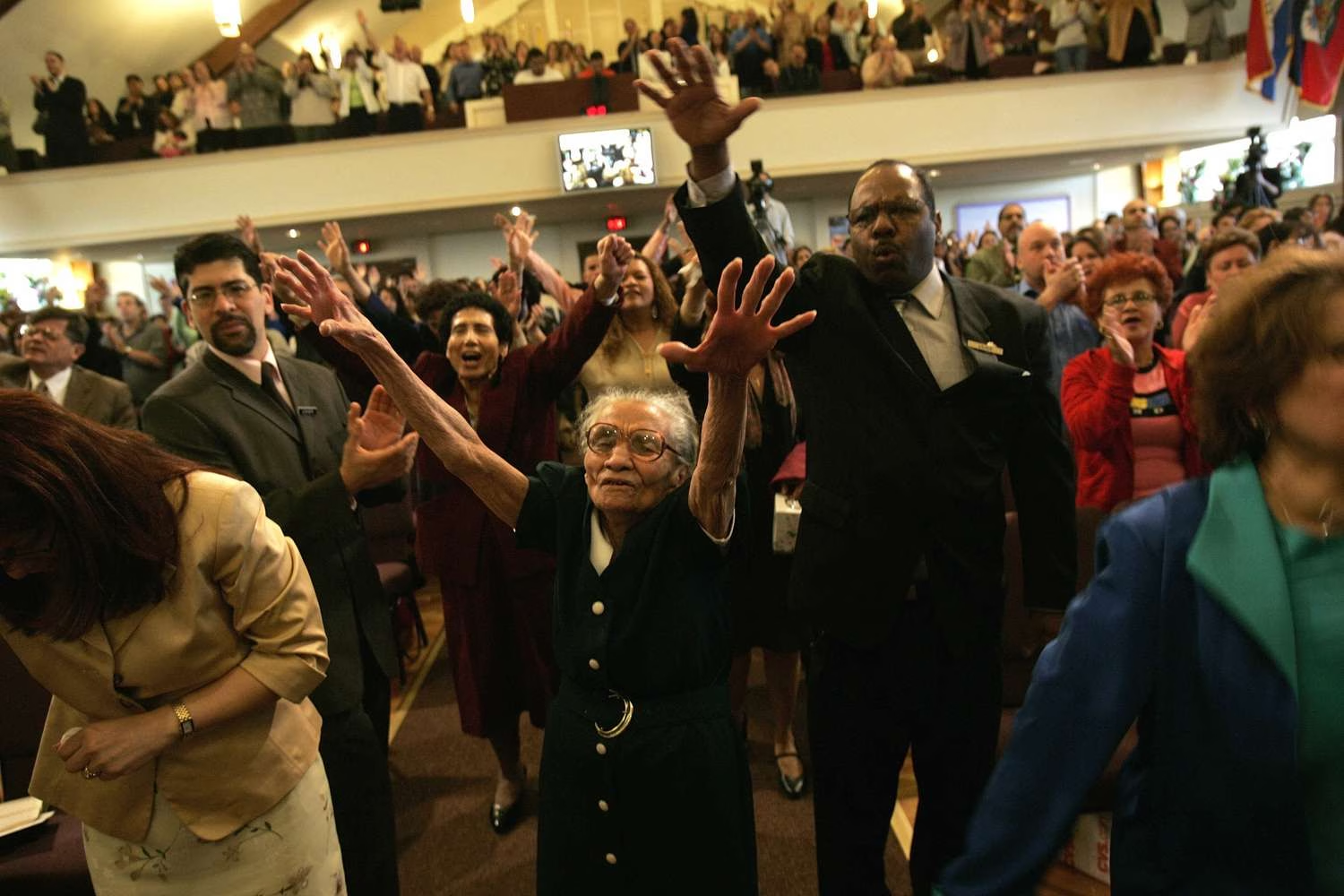
One of the most debated subjects in the Christian life concerns the baptism in and filling with the Holy Spirit. Throughout the twentieth century, Pentecostal and Charismatic movements profoundly influenced millions of believers around the world. Many Christians testify to powerful experiences that transformed their prayer lives, worship, boldness, and spiritual growth. Because of this, we must carefully ask what Scripture teaches about these experiences and how they relate to the work of the Holy Spirit in the believer’s life.
The modern Pentecostal movement traces its roots to revivals that began in the early 1900s. Pentecostals traditionally teach three main ideas. First, they believe that baptism in the Holy Spirit is an experience that occurs after conversion. Second, they often teach that speaking in tongues is the initial evidence of this baptism. Third, they affirm that all spiritual gifts mentioned in the New Testament continue to operate today.
The later Charismatic movement emerged during the 1960s and 1970s within existing Protestant and Catholic churches. Unlike Pentecostals, Charismatics generally remained within their denominations rather than forming new ones. While many Charismatics also believed in a post-conversion experience of empowerment, views differed concerning whether speaking in tongues was necessary evidence.
A later movement, sometimes called the “third wave,” argued that baptism in the Holy Spirit occurs at conversion itself. According to this view, what many people describe as a “second blessing” is better understood as a filling or empowering of the Spirit rather than a separate baptism.
To understand these differing views, we must examine the biblical use of the phrase “baptism in the Holy Spirit.” The expression appears only seven times in the New Testament. Four of these references occur in the Gospels, where John the Baptist announces that Jesus “will baptize you with the Holy Spirit.” These passages point forward to a future work of Christ through the Spirit.
The next references occur in the book of Acts. In Acts 1:5, Jesus tells His disciples that they will soon be baptized with the Holy Spirit. This promise is fulfilled at Pentecost in Acts 2, when the Spirit comes upon the disciples with power. The final and most important reference appears in 1 Corinthians 12:13: “By one Spirit we were all baptized into one body.”
This passage is critical because Paul states that all believers have been baptized by the Spirit into the body of Christ. The language is universal. He does not describe a special class of Christians who have had a second experience. Rather, every believer shares in this baptism.
This suggests that baptism in the Holy Spirit occurs at conversion, when believers are united with Christ and incorporated into His body, the Church. If this is true, then how do we explain the powerful “second experiences” many Christians have described?
The answer lies partly in understanding the unique role of Pentecost in redemptive history. Pentecost was a transitional event that marked the movement from the Old Covenant to the New Covenant ministry of the Holy Spirit. Under the Old Covenant, the Spirit came upon selected individuals for special tasks and often in temporary ways. Under the New Covenant, the Spirit permanently indwells all believers.
The apostles themselves lived during this transition. They believed in Christ before Pentecost, but they did not yet experience the fullness of New Covenant empowerment until the Spirit descended upon them. Pentecost was therefore a unique historical event that cannot simply be repeated in exactly the same way today.
The book of Acts also records several unusual experiences involving the coming of the Holy Spirit. In Acts 8, the Samaritans believed the gospel but later received the Holy Spirit through the laying on of hands by Peter and John. In Acts 10, the Gentiles received the Spirit as Peter preached to Cornelius and his household. In Acts 19, disciples of John the Baptist encountered the fuller message of Christ and received the Spirit afterward.
These events reflect the progressive expansion of the gospel from Jews to Samaritans to Gentiles. Acts is a transitional book that records the historical unfolding of God’s redemptive plan. These experiences should not necessarily be treated as universal patterns for all believers in every age.
At the same time, we should not dismiss the genuine spiritual transformation many Christians have experienced after conversion. Some believers testify to dramatic renewal, deeper surrender, increased boldness, greater intimacy with God, or a heightened awareness of the Spirit’s power. These experiences are real and often life-changing.
The question is not whether such experiences happen, but how best to describe them biblically.
Scripture most commonly uses the language of being “filled with the Spirit.” In Ephesians 5:18, Paul commands believers: “Do not get drunk with wine…but be filled with the Spirit.” The verb here carries the idea of continual action. It could be translated, “be continually filled with the Spirit.”
This filling is not a one-time event but an ongoing process of yielding ourselves to God’s control. Paul contrasts drunkenness, where a person is controlled by an external substance, with Spirit-filling, where a believer is controlled by the indwelling Spirit.
The results of Spirit-filling include worship, gratitude, obedience, and mutual encouragement. Throughout Acts, people filled with the Spirit often display boldness in witness, wisdom in ministry, and power for service. Tongues may occur in some instances, but they are not presented as the universal evidence of the Spirit’s filling.
It is important to avoid creating a “two-class” Christianity that divides believers into superior and inferior categories. Spiritual growth is not identical for every person. Some grow steadily over many years through prayer, Scripture, and faithful obedience. Others experience dramatic moments of renewal that accelerate their spiritual development. God works differently in different lives.
Spiritual growth is best understood as a lifelong process rather than a single event. There may indeed be seasons of special empowerment or breakthrough, but these should be viewed as part of an ongoing relationship with God.
Many practices often associated with seeking the “baptism of the Spirit” are actually healthy biblical disciplines for every believer. Christians are commonly encouraged to confess known sin, surrender themselves fully to God, trust His promises, and yield to His purposes. Such practices naturally lead to greater spiritual vitality and openness to the Spirit’s work.
In this sense, many believers have experienced something real even if the terminology used to describe it may not always be precise. Their experience of God may be deeper than their theological explanation of it.
The inward work of the Spirit produces maturity, holiness, and Christlike character. The outward work of the Spirit empowers believers for ministry and service. Both dimensions are important. The Spirit not only changes who we are but also strengthens us for what God calls us to do.
Ultimately, the Christian life is one of continual dependence upon the Holy Spirit. We begin by admitting our weakness and our need for God’s strength. We confess sin and ask the Spirit to reveal areas that require surrender and cleansing. We present ourselves to God as instruments of righteousness. And we trust His promise to empower and guide us.
The filling of the Spirit is not reserved for a spiritual elite. It is the ongoing privilege and calling of every believer. As we yield ourselves more fully to God, the Spirit increasingly shapes us into the image of Christ and empowers us to participate in His purposes.
To explore this topic more deeply and discover how to thoughtfully answer the questions below, subscribe to Ken Boa Reflections on Substack.
Questions for Reflection
- How has your understanding of the Holy Spirit been shaped by your background, church experience, or personal journey of faith?
- Paul commands believers to “be continually filled with the Spirit” (Ephesians 5:18). What practices or attitudes help you remain open and responsive to the Spirit’s work in your life?
- Have you experienced a season of spiritual renewal, deeper surrender, or greater empowerment in your walk with Christ? What do you believe God was teaching you through that experience?
- The Holy Spirit works both inwardly to produce Christlike character and outwardly to empower ministry. In which of these areas do you most desire to grow during this season of your life?